
Omelas
How I Spent My Winter Vacation

Trigger Warning: This post describes in detail what I heard and saw while engaging in protective presence in the West Bank this winter. It contains descriptions of violence.
As I told the woman at passport control, the last time I was in Israel was May 2023. It was different then. Sort of. I’d prepared more answers: an unspecified Hashomer Hatzair program, 3 weeks, Jerusalem, the Swedish Theological Institute, oh, unspecified educational programming. Hanukkah stuff.
But she didn’t ask me any more questions, just waved me on towards baggage claim, and I went.
The summer before my senior year of college, I was asked if I’d be willing to run a class based at my university’s Hillel that was focused on dialogue around Israel/Palestine. It took me a week, several phone calls to friends and family, and a tearful sit-down with the Catholic chaplain to say yes. It was probably the best thing I did in college. But for all of Gesher’s strengths, it was, at the end of the day, American college students talking about American discourse. It felt a little disconnected.
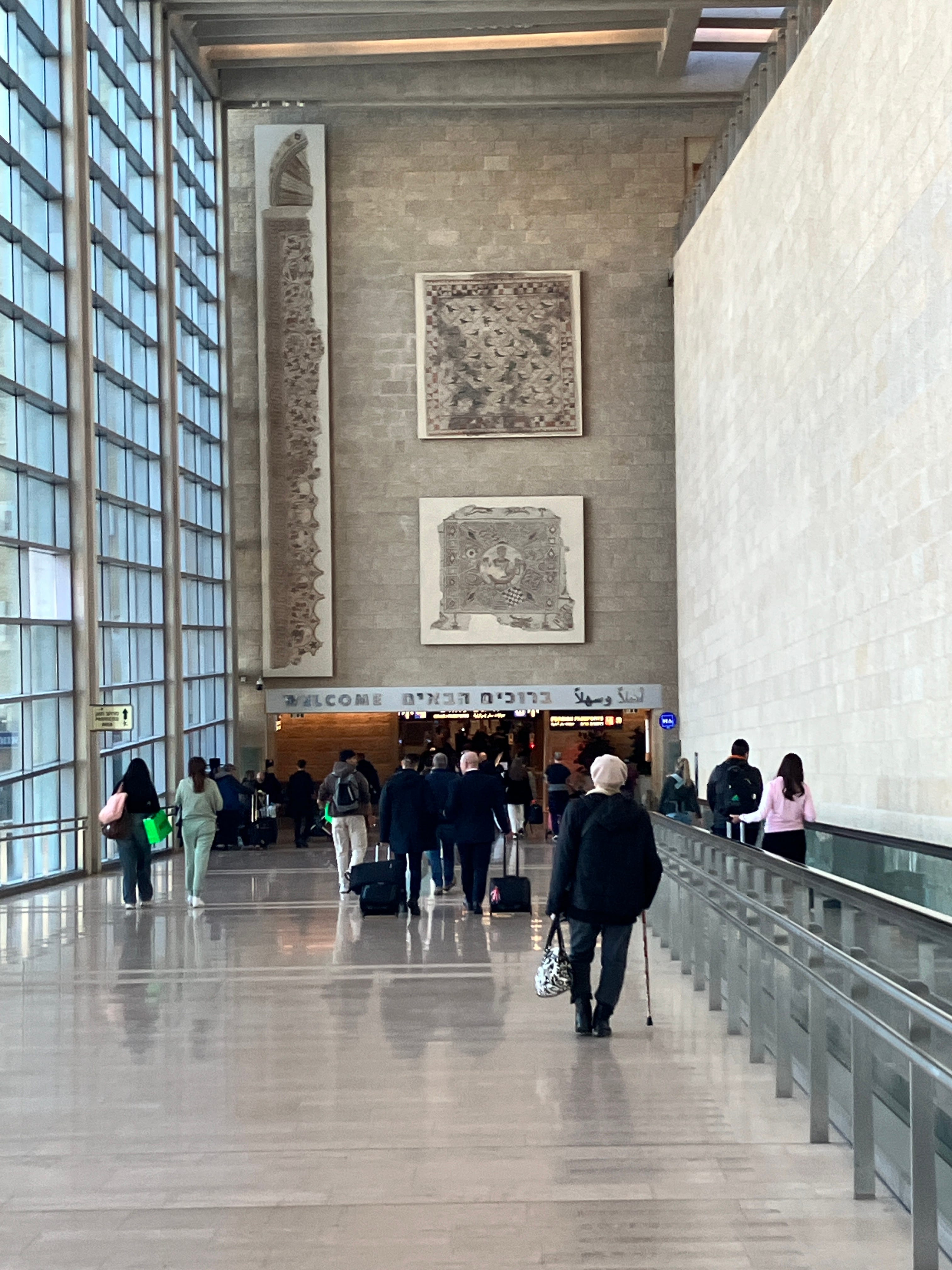
And then I was in Kazakhstan, teaching my little classes and eating my little pastries and going for my little walks. Watching a country that I love (really!) become the worst version of itself and feeling that I just was not in the right place. I needed to be there. So I applied for and was interviewed for and was accepted to Achvat Amim’s Winter Solidarity Cohort, and now I was texting my aunt that I’d arrived, and now I was walking down the famous ramp, and now I was taking, for reasons I still can’t quite parse, maybe habit, maybe hope, the picture you have to take at the famous ramp, the one that tries to tell you you’re home.
Three days in, after we’ve done the setting-our-group-norms and the get-to-know-you’s, and drawn diagrams that illustrate our Israel journeys, and gone to Machane Yehuda for sufganiyot, and stayed up until 2am on Shabbat talking, and wandered around Jerusalem trying to find our Shabbat lunch hosts, we go on a tour with Breaking the Silence.
Amir, our guide, takes us on a tour of Massafer Yatta, a region of the West Bank south of Hebron. For the first few hours I take careful notes on Amir’s childhood in a center-right Israeli family, his army service in Hebron, his job at a boarding school, and his eventual path to Breaking the Silence. I take careful notes on how we’re stopped at the checkpoint and get off the bus to have our passports inspected. I take careful notes on the settlements.
Only one new settlement has been built since the Oslo Accords were signed in 1995. Instead, the settlements expand by building new neighborhoods in existing settlements, and also by setting up new outposts. More than 200 outposts have been built since Oslo, and unlike the Palestinian villages that they surround, the settlers have water, sewage, electricity, paved roads, and civil rights.
An outpost can be a trailer on a hill, a thriving farm, or a guy with a gun who lives in a cave and says that it’s his now. It doesn’t matter. The vast majority of the time, these outposts have state power behind them, even to the extent of the state providing them with ATVs.
Settlements are illegal under international law and legal under Israeli law. Outposts are illegal under both.
All over Area C, settlers are building. Palestinians, on the other hand, have made 5,155 requests for building permits since Oslo. 75 have been granted. But people have to live, so they build their houses anyway. The Bureau of Civil Administration, the IDF unit that controls civil matters in the West Bank, has issued over 18,000 demolition orders for Palestinian homes, wells, barns, and schools, including those built on land that Palestinians own.
After the checkpoint, we pull over near the Talya farm, skirting off the road to let a truck pass by. The truck is driven by Yedidya Talya, whose father’s farm up the road is an illegal outpost. Yaakov Talya moved to Israel from South Africa, converting to Judaism and making aliyah after apartheid fell.
The Talya family and a crowd of troubled teens they “mentor” are known to attack Palestinians in the area, operating with pretty much total impunity. Amir points to a village down in the valley, and explains that settlers like to go there, walk into Palestinian houses with their guns and just sit in the living room. Maybe smoke a cigarette.
There are two sets of laws in Area C, which comprises 60% of the territory of the West Bank. Israelis and foreigners are subject to Israel’s civil law, just like we would be within the 1948 borders. For Palestinians, the law of the land in Area C is the Civil Administration, a unit of the IDF. This means that the estimated 300,000 Palestinians in Area C are subject to military law, where there is no minimum age of responsibility, and even a speeding ticket is a security matter.
Soldiers are (falsely) told they can’t enforce the law on settlers. Police refuse to. 95% of complaints made by Palestinians against settlers are not even investigated.
At some point I stop taking notes. The bouncing bus is making me nauseous. Not just the bus. The terraced hills and valley vineyards roll by. I’d never known that grapevines also change color in winter, but the leaves are a fiery orange, all of the vines wrapped in blue jackets.
Amir explains how some of his family and friends stopped talking to him when he started working for Breaking the Silence. How people hate him. How people call him a traitor. As we reenter Jerusalem, he explains a new bill in the Knesset that will tax Breaking the Silence’s foreign funding at such a high rate that it might as well not exist, another effort on the government’s part to shut them down. Amir calls it a “carbon copy” of Russia’s foreign agents bill.
Over the course of the morning, Amir explains how we want as much land as possible with as few Palestinians on it as possible. He explains how we issue demolition orders so that we can threaten political dissidents with the destruction of their homes. He explains how the youngest person he’s ever arrested was 9 years old, and he didn’t have to call anyone to tell them where the child was. He explains how we use a law dating back to the Ottoman Empire to take “unworked” land. He explains how we stop Palestinians from working that land, their land, with guns and tractors and sticks.
He always, always says “we.”
We spend a day and a night in Umm al-Khair, a Palestinian village in the South Hebron Hills. It was founded by Bedouins after they were displaced from the city of Arad in southern Israel. They bought the land from its owners, who lived in the nearby city of Yatta. In 1980, settlers began building the moshav of Carmel next door, on land seized from Palestinians by a “military seizure order.” Separated from the village by a barbed wire fence, Carmel looks like anywhere else. Like California. Orange trees. Cacti. Cars, trucks, electricity, water, paved roads.
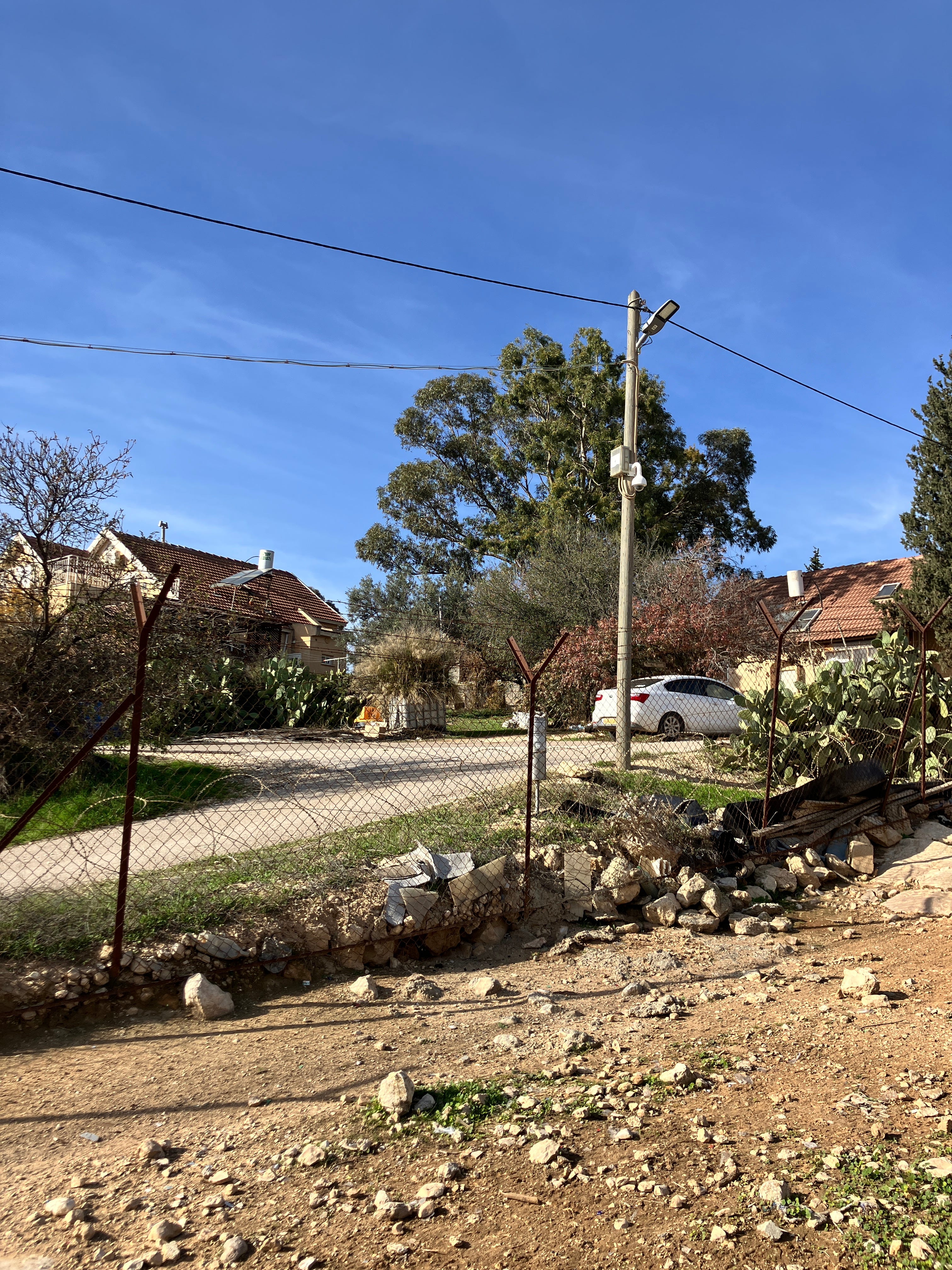
The homes in Umm al-Khair are not connected to the national electricity grid. Residents buy their water in huge tanks, at high prices. Many of the houses seem more like temporary shelters, and the village is littered with debris from the last round of demolitions. To stand in Umm al-Khair and look at Carmel makes me dizzy. I wonder what it feels like to live behind that fence. I wonder how long it takes to just stop seeing it.
A Carmel resident named Yaakov Goldenshtein was upset about the smoke produced by the community oven (the fact that he had picked up and moved himself purposefully to an illegal settlement mere feet from said oven notwithstanding). He complained to the army, and the army demolished the oven that fed almost 50 people in the village every day. So the villagers rebuilt the oven. The army came back and demolished it. They rebuilt the oven. The army came back and demolished it. Three times in one week. There is no community oven in Umm al-Khair.
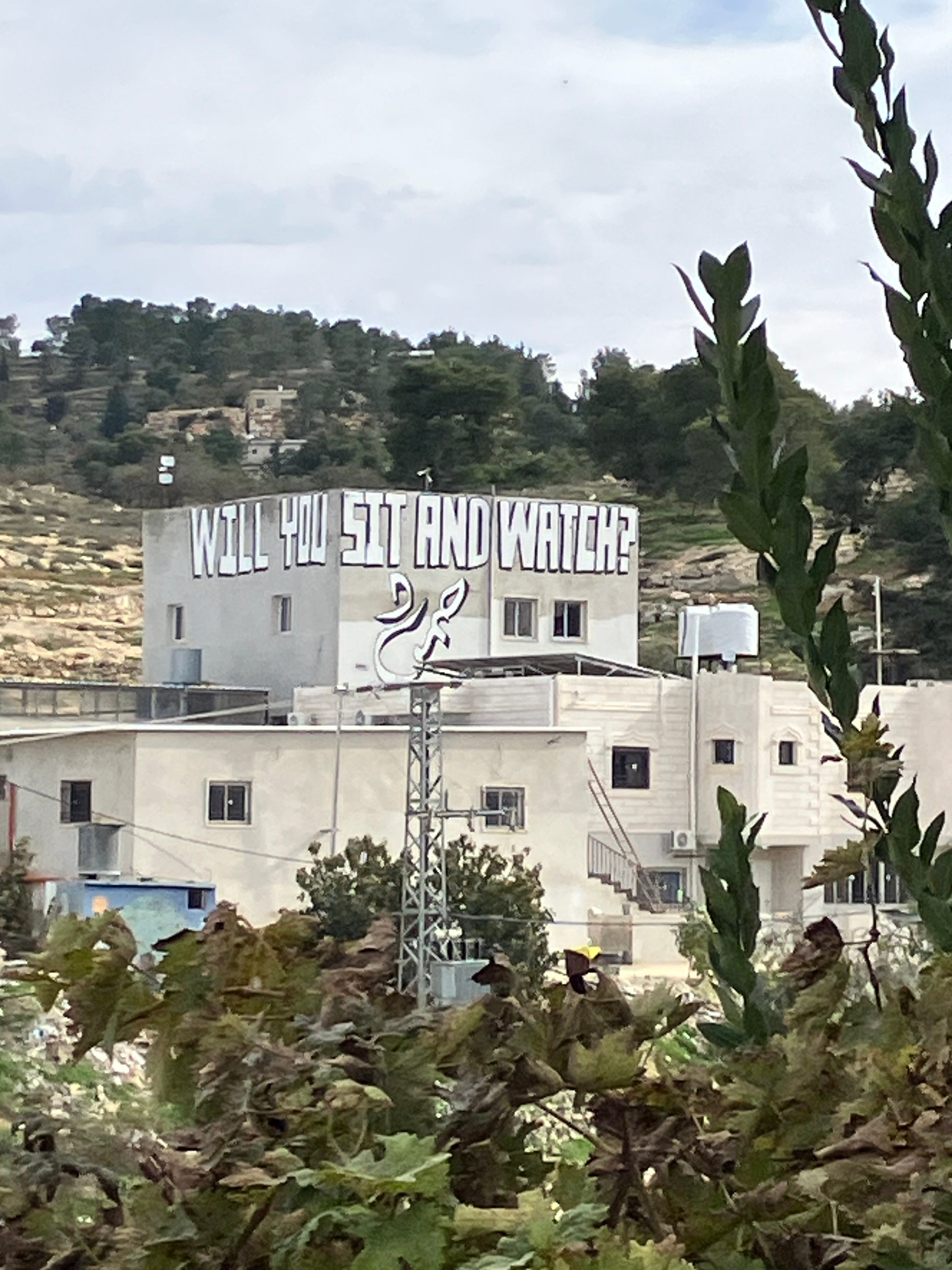
Next to the playground in Umm al-Khair is a mural in memory of Haj Suleiman, a beloved community leader who was killed on the village’s only road in 2022, crushed under an Israeli tow truck. Drinking a cup of strong, sweet tea, on a playground bench 50 feet from the place where he died, I googled his name and read the first result: an article about him written by his nephew Awdah. Awdah describes “the loss of a defender of our people who brought his characteristic nonviolent resistance to all spheres of our life.” He writes that he is “scared every time [he hears] news of another raid by Israeli soldiers, or another assault by Israeli settlers — [he’s] afraid of losing someone else.”
Awdah is dead now. He was murdered this summer by a settler named Yinon Levy. He was holding his baby son. Yinon Levy was released the day after the murder. Awdah’s brothers were arrested. Yinon Levy still walks around the village whenever he wants. A few weeks ago, trailers popped up overnight in the middle of the village. A new neighborhood of Carmel. The villagers of Umm al-Khair complained to the army, who told them that yes, the new outpost was illegal, but they wouldn’t give an order for it to be destroyed, because they’re planning to legalize it. The settlers have put up an eruv around the villagers’ olive grove.
We join the women gathered in his widow’s house. She’s 26, with three sons who climb all over her and us. The youngest, who was in Awdah’s arms when he was shot, has not started talking, although it’s past time.
From my sleeping bag in Umm al-Khair, I check my email. Would I like to “Staff a 10-Day Birthright Trip?”
Hmm. No thanks.
During our overnight, a group of settlers broke into a Palestinian home near Susya, about 5 kilometers away. They beheaded two of their sheep and sprayed pepper spray into the home. All four children were hospitalized. The youngest, 6 months old, was still in the hospital when we were told about the attack the following afternoon.
I get Ethiopian food with my friend Sarah, who is visiting her sister in Tel Aviv and has hopped over to Jerusalem to see me for an afternoon and evening. It’s really good. I am trying to tell her about the eruv in Umm al-Khair but it makes me cry and I have to change the subject.
In the village of Tuwani, Shoug al-Adara describes to us how her husband was shot point-blank by a settler, who has never been arrested or charged despite being caught on video. When her husband’s family went to make a complaint, the Israeli police fined them and threatened them with arrest.
We leave her home and walk a little less than a mile up into the hills, where a man in his sixties tells us that he had put up his own barbed wire around his land. He felt forced to do so after nearby settlers started intentionally running over his sheep with their tractors. But now, he says, the children are trapped too, and can’t roam the hills the way they used to. “We suffocate ourselves to live”, he says.
For two nights of the program, we have dinner at Paulus House, which was built by German Catholics. On our second visit, the head of the foundation takes us up to the roof, points out the church spires and synagogues and minarets of the Old City. The tax status of Paulus House is changing next year, and they’ll no longer be exempt from certain kinds of taxes. He laments that the same issue is being faced by peace and coexistence organizations, many of whom are being levied with taxes intended to drive them out of business. A coexistence nonprofit he knows got a letter from the municipality of Jerusalem announcing that they no longer qualified for a public interest tax break. “Peace” he quotes from the letter, “is not in the public interest.”
In between hearing some of the worst, most haunting things I’ve ever heard, I’m having so much fun that I feel bad about it. I wander Machane Yehuda. I wander the alleys of the Old City. I eat rugelach with the cohort, and we talk late into the night. I go to Yemeni Falafel down the street, watching the Orthodox man who owns it shape the falafel at lightning speed, peyos swinging. I admire Jerusalem’s light. I go to the Kotel four times in three weeks, sometimes with others and sometimes alone, trying desperately to feel that it is something more than a pile of rocks. I make several visits to an antique store. I buy a bracelet made of eyes, to keep us safe. I go to the Educational Bookstore in East Jerusalem, where the owner’s nephew very politely pretends to remember speaking to my college dialogue group last year. I go up to the roof of the Austrian Hospice, a Christian guesthouse in the Armenian Quarter, and admire the view. I talk to and laugh with and bentch with and dance with all of the wonderful fascinating people in this cohort and we celebrate Chrismukkah and New Year’s and three birthdays and eat a lot of Ethiopian food. I see two good friends from college and take George (yes, George is here too, (longtime readers may remember George)) to my aunt’s house north of Tel Aviv and we have a lovely Shabbat there. I pet a lot of cats.


Palestinian hospitality is legendary, and everywhere we go we’re offered tiny cups of strong coffee, or larger ones of sweet black tea. Often there’s bread and olive oil and za’aatar and labneh, all of it incredible. In our cultural sensitivity training, we’re instructed to never try to help with cleanup, so as not to dishonor our hosts. As a Midwesterner, I find this difficult, but I sit on my hands.
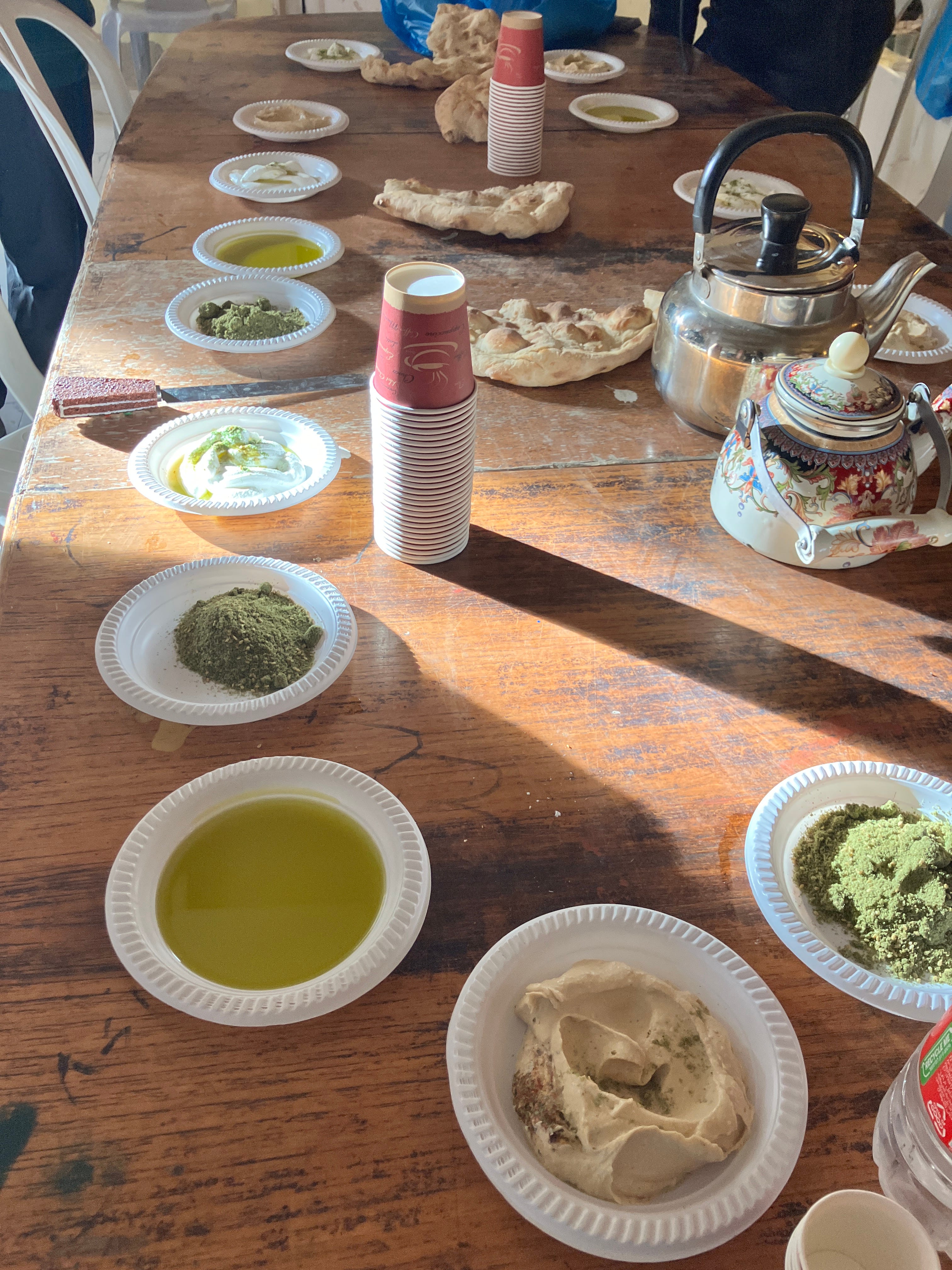
For “environmental reasons” it is illegal to pick za’aatar in the West Bank. In theory, this law applies to everyone. In practice, za’aatar is central to Palestinian culture and cuisine, and the law is only enforced against them.
A group of us spend the night in Farsiya, near Jericho. We were supposed to leave in the morning but it was pouring rain and gusting wind so we leave Jerusalem at 2pm. Then someone forgets their passport, then someone else has forgotten their medication, so it’s after 2:30 by the time we’re really on the road. We head north north north, and east. I spot the Dead Sea out the window, then a rainbow. The greenery gets greener.
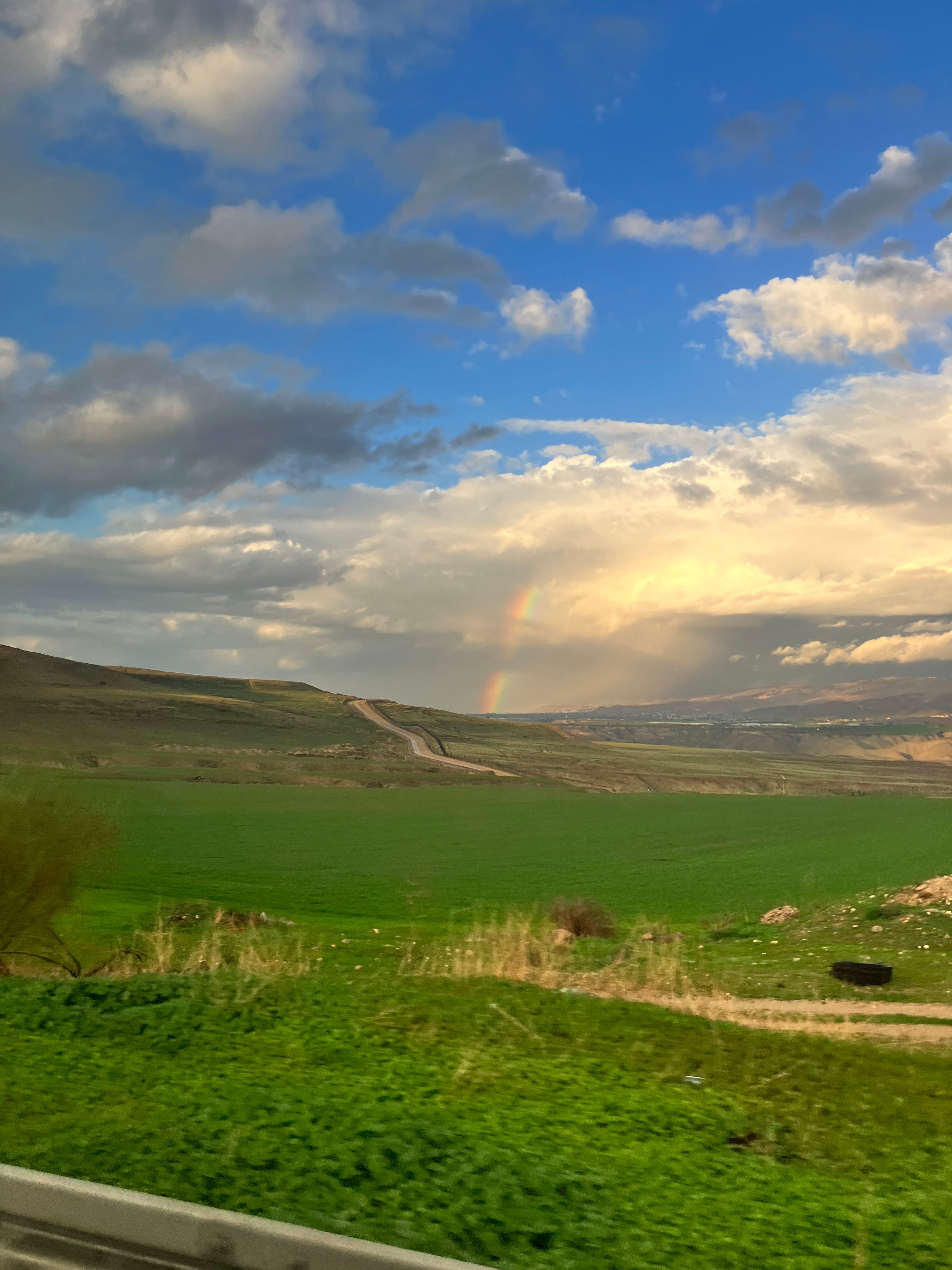
Al-Farsiya is essentially a large extended family, three brothers and their children and grandchildren. We eat dinner with Z. About a year ago his tractor was confiscated by the IDF. Last week he got it back, and the settlers up the hill poured sugar in the engine. It’s unusable. He can’t plow his fields.
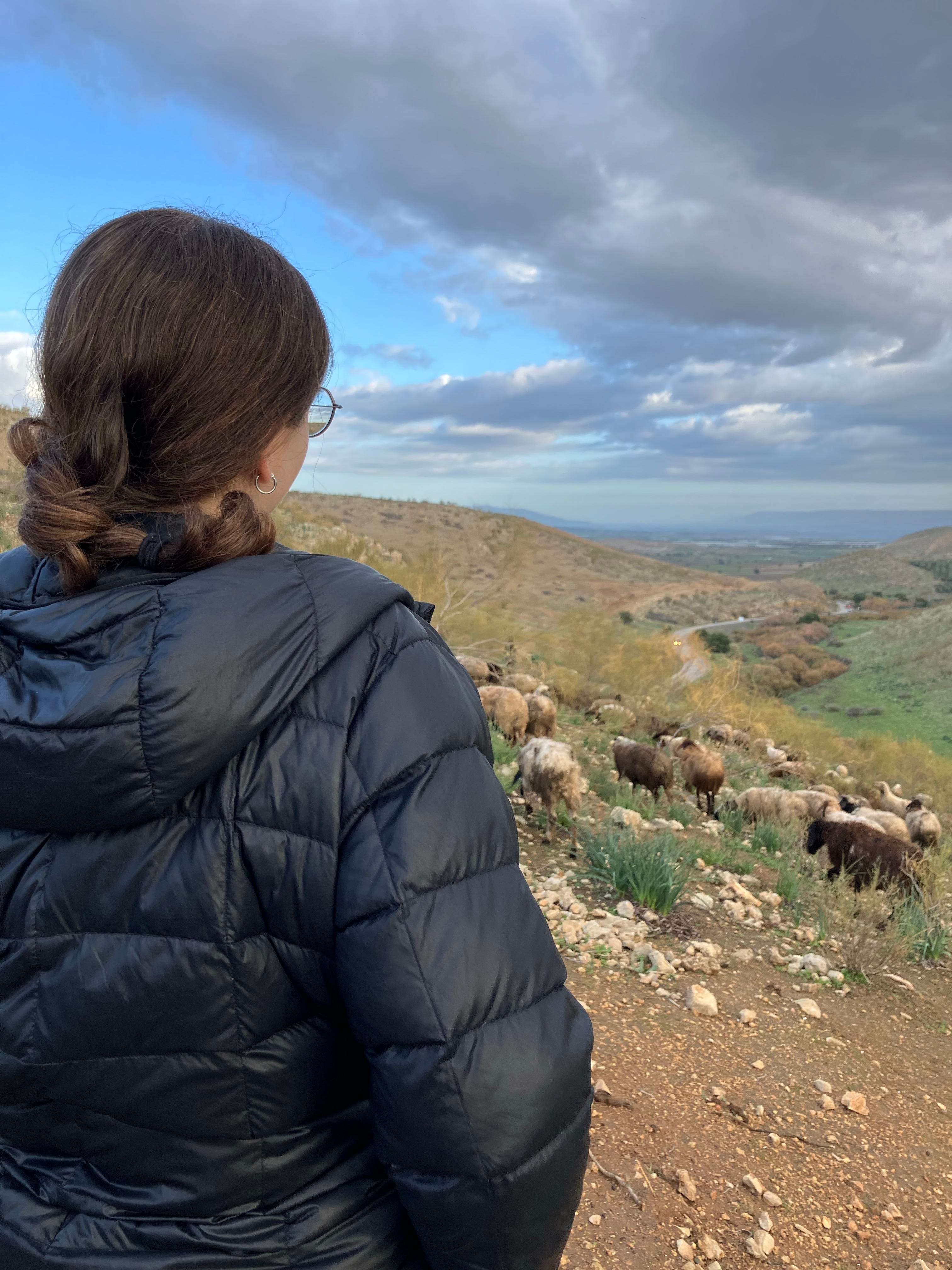
Z used to take his sheep all around the surrounding area. Settlers put up fences just around the four or five buildings of his village, and now there is nowhere for the sheep to graze. There’s so much food, he says, the hills are green, but he has to buy outside food for his animals. His livelihood depends on being able to care for his flock, and now he can’t earn a living.
Another family who lived nearby owned 180 sheep. Settlers killed 70 of them, a $40,000 loss. That family moved to Jericho, and the settlers took over their land.
In the north Jordan valley, as in most of Area C, most Palestinians are farmers and shepherds, Their wealth and their livelihoods are tied up in their land or their animals. When settlers kill their livestock and block their access to their land and force them to flee to cities, even a comparatively wealthy family can be left with nothing.
Farsiya is near the settlement of Rotem. It’s also near an illegal outpost (of course, the settlement is also illegal under international law) started by Didi Amosi. Didi’s 20-something year old son, Gilad, obsessively harasses the village, including coming into people’s houses and threatening the children on their way to school.
Last year the Amosi family stopped the villagers from planting. This year they managed to plant chickpeas and lentils, and Didi promptly plowed over the fields, rendering all their work useless.
Anywhere outside the village is forbidden territory. The grandparents live very close, but they don’t see their grandkids unless an Israeli or foreign volunteer drives them over. One of the women tells us that a few weeks ago she tried to take her son to a nearby clinic for a fever. A soldier stopped them on the road and detained them in the December cold for 6 hours, then sent them back to the village. She never made it to the clinic.
My roommate and I spend the night with the grandparents. For us, it’s just a five minute drive down the road. Easy as anything.
The last weekend of the program, a few of us go for Shabbat lunch at the home of a Reform rabbi. Her extended family is visiting, and her niece and I are arguing from down the table.
She asks why we don’t protect the Jewish villages in the West Bank, why we “only help the Arabs.” Our host’s nephew agrees. I say that the army and the police protect the settlers. “So that’s okay then,” says the nephew. “You protect the Arabs and the army protects the Jews. Equal.”
I’m not sure what to say to that.
The nephew has recently become more Orthodox, and he studies at a yeshiva in the West Bank. “Why are you Reform, and not Orthodox?” he asks me. I tell him that I tried being Orthodox and it didn’t really work for me. He seems to accept this.
The nephew tells me that he believes that the future will be better because the Talmud says so. There’s an argument in the Talmud about whether redemption will come even if Jews do not do tshuva (often translated to English as repentance). The Talmud concludes that it will. No matter what, redemption will come. “You can have redemption without tshuva”, the nephew says. “So I’m not worried.”
The next day, Sunday, Maya Savir comes to talk to us about transitional justice. She’s worked in South Africa and Rwanda, and she’s talking about the peace process in both places.
After the Rwandan genocide, in which over 700,000 people were killed and between 250,000 and 500,000 women were raped in 100 days, mostly by their neighbors, the government set up over 12,000 local “Gacaca courts” across the country. These courts were based in traditional Rwandan justice systems, focusing on communal healing. While the success of the Gacaca courts is contested, Maya seems to feel that they were a step in the right direction, and it’s true that Rwandans today live in relative harmony.
Maya says there can be reconciliation without forgiveness.
We’re doing a learning session in the upstairs room at the Swedish Theological Institute. At some point I stopped listening. Outside the window, the sun is beginning to set. Jerusalem light on Jerusalem stone. It sends a beam of light that’s almost blinding.
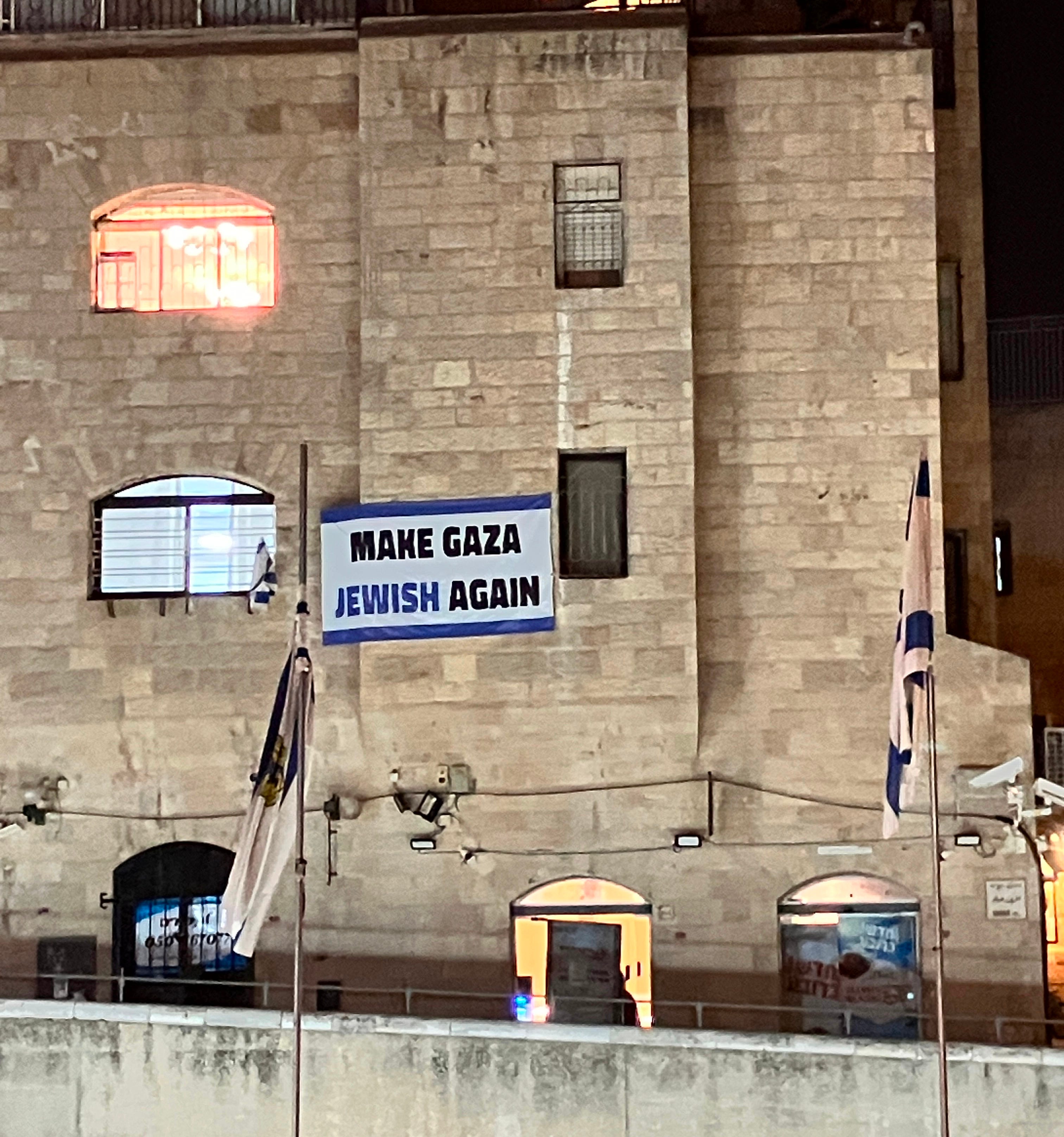
There’s more. There’s always more. I have pages and pages of notes on demolished homes and schools, stolen lands, tortured sheep. Children escorted to school by soldiers, children who go to school just 3 days a week (if their teachers--who have not been paid for months--can get through the checkpoint), children who don’t go to school anymore because the road is not safe for them, or because the army has closed the yellow gate to their village and no one can leave. Men arrested arbitrarily and beaten, held blindfolded and handcuffed for hours before being released miles from home with no way to get there. Women attacked in their homes. Lives and livelihoods destroyed.
These stories are samples of a wider, horrifying whole. This is a campaign of ethnic cleansing, a systematic effort to force Palestinians off of their lands in Area C into the overcrowded cities of Area A, to create Palestinian population centers that are poor, isolated, and take up very little space. This is a plan to kill the idea of Palestinian statehood. To kill the idea of Palestinian identity.
It’s not a few violent settlers, a few “bad apples.” It’s the army, it’s the Minister of Finance and the Minister of Security. It’s the state. Bezalel Smotrich, the man in charge of all Palestinian affairs in the West Bank, is a violent settler and a self described fascist who once called for separate Jewish and Arab maternity wards. And every day it gets worse.
At the end of these horrific recitations, we ask questions. Someone always asks “what can we do for you?”
Every time, the Palestinians we meet with ask us to speak. To tell other people what we saw, what we heard.
Over and over, we hear two things. One is that after October 7th, everything got worse. Local and international attention diverted to the Gaza Strip. Soldiers were also diverted. To make up the shortages, the IDF called in reserves, who generally serve near their homes. In the West Bank, that means that the soldiers and settlers became one. We heard stories about settlers waiting until they knew their friends were on duty to carry out attacks on villages. Since October 7th, when villagers need help, they call activists. Almost no one bothers to call the police.
The other thing I’m struck by is how much these people are known quantities. When they show up to harass Palestinians, activists call them by name. Amir recognizes the man in the truck. Villagers know all about the settlers who surround them. In Umm al-Khair, a man drives through the village, slowing down to glare at our group and then speeding off to Carmel. Our guide tells us his name, and that his family in New York got in touch with the villagers through international activists to apologize for their asshole relative. What a world.
There were many things about this trip that made me hopeful. Frankly, it has been very difficult in the last two years to see my place in the Jewish world. I have found many mainstream Jewish spaces very alienating. I’ve been deeply troubled by the rhetoric I’ve seen from people and organizations that I trusted and respected.
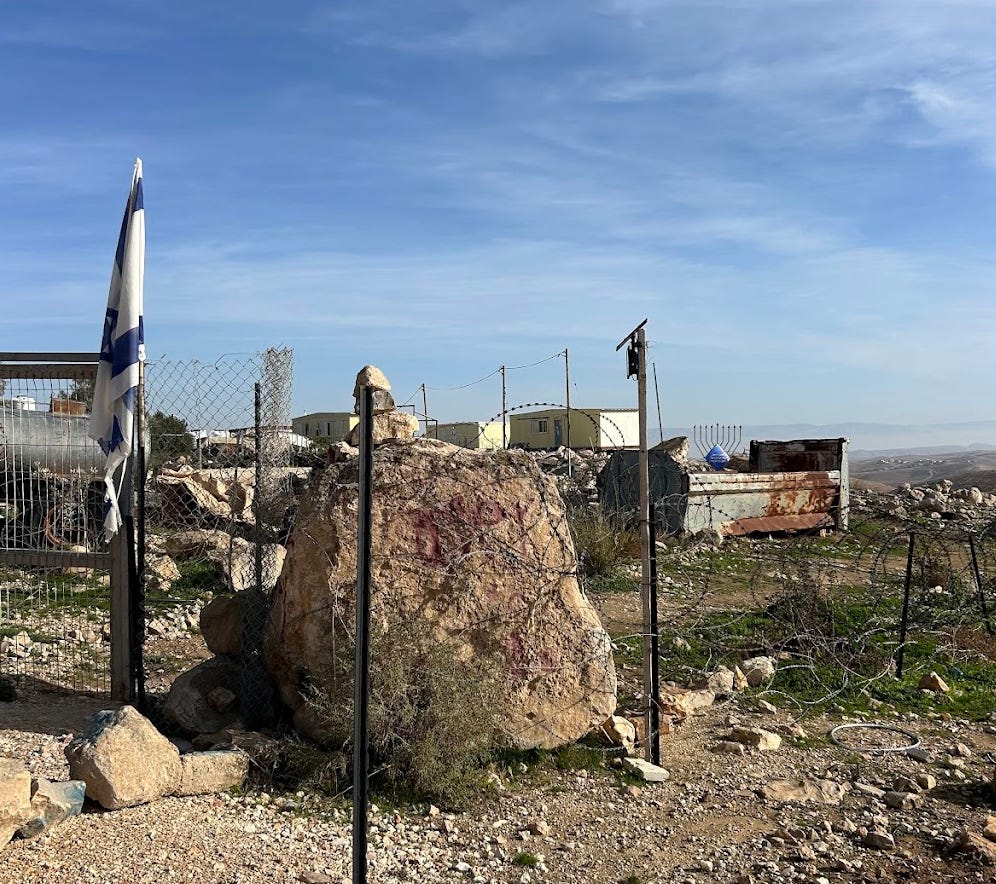
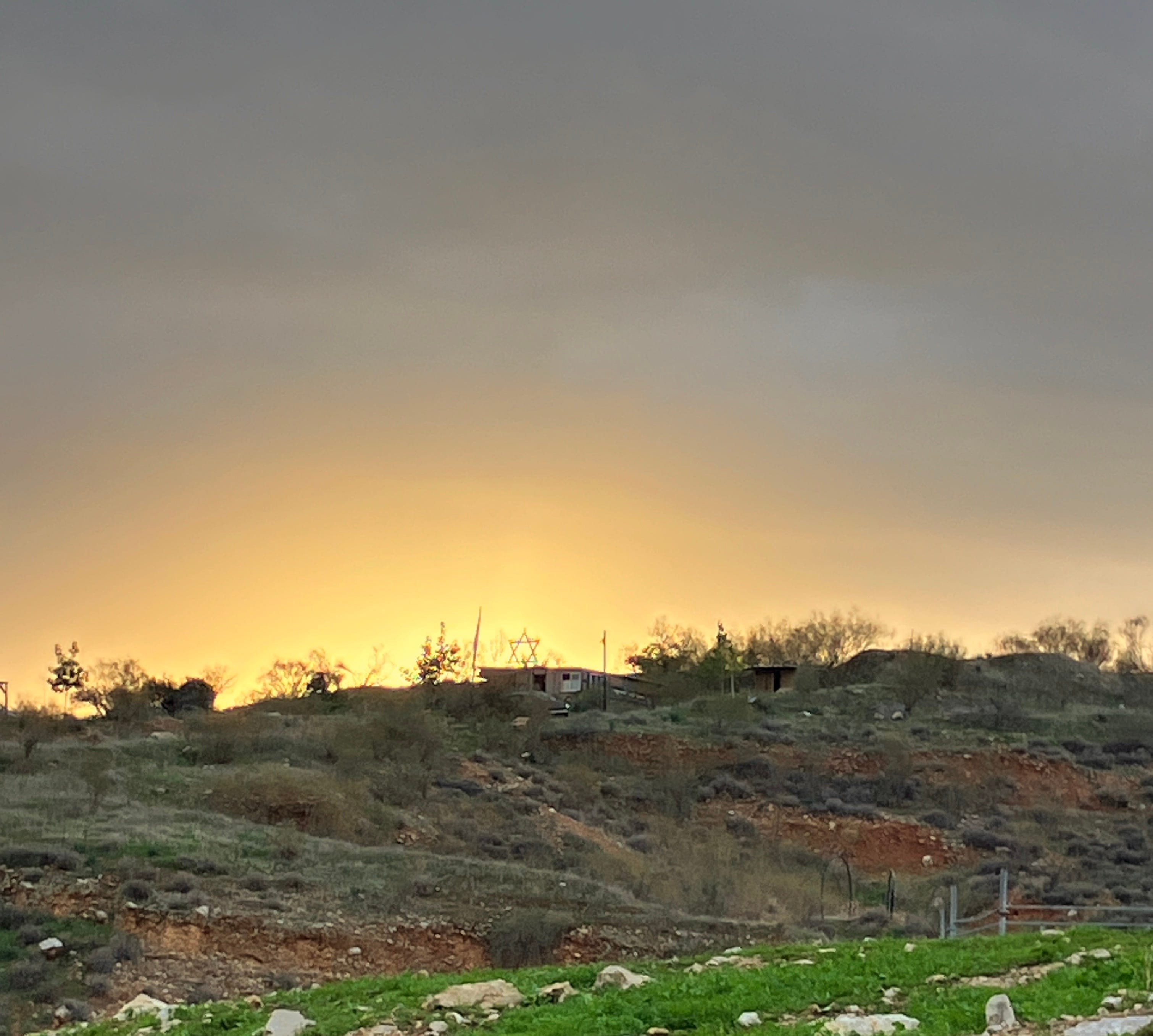
As much as it hurt to see the Star of David raised over stolen land, it helped to meet Jews, from Israel and abroad, who are dedicating their lives to justice. As much as it disturbed me to see a menorah in the Carmel outpost, it was beautiful to light the Hanukkah candles with our group. It was so good to sit around a Shabbat table with a Breaking the Silence staffer and hear about his work. It felt so right to read Rashi sitting in a circle at the Dung Gate. In Jerusalem, in Beit Jala, in Umm al-Khair, talking to the activists we met, I could once again begin to see a Jewish future for myself.
On our first field day, we replace burnt-out olive trees for a farmer in Battir, just west of Bethlehem. There are too many of us, buses of volunteers from Haifa and Jerusalem and Tel Aviv, and not enough shovels and picks, but the farmer seems glad to have us, and patiently corrects our mistakes. And Battir is beautiful. The terraces, optimized for water delivery, are considered a UNESCO world heritage site.
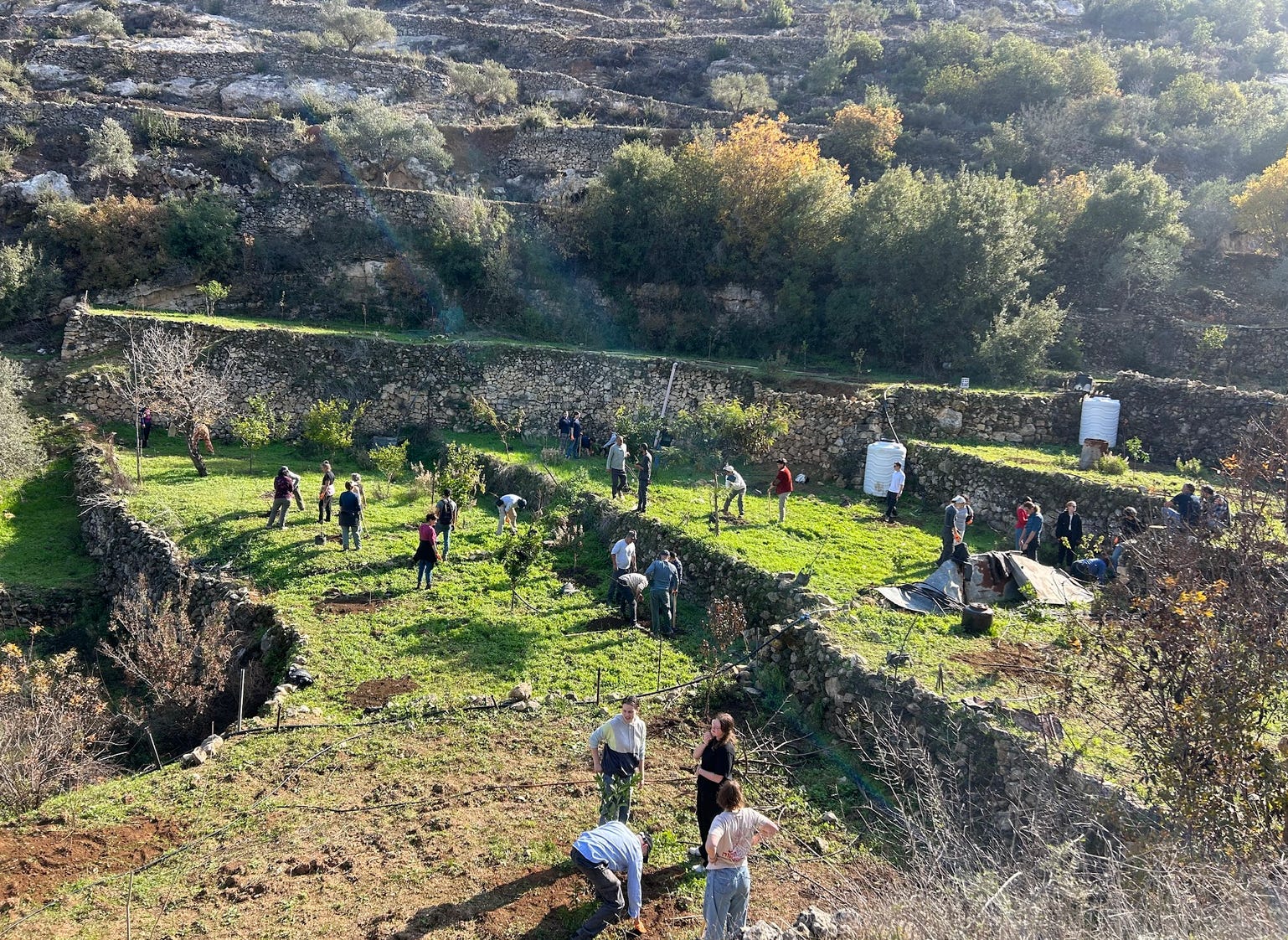
We plant trees for a few hours, and then head home to beat pre-Shabbat traffic. As we’re about to leave, a drone comes flying overhead. Everyone tenses, but it leaves without incident. Two weeks later, I’m crying in the Istanbul Airport, watching a video of the barren terraces.
Settlers have come in the night and ripped up all the trees.
I struggled with how to write this post, mostly because I want to show you all of it. I want to tell you about the pain and the fear and the way the violence echoes. I want to tell you about the sheep, about the sunlight, about the mud-snowshoes that formed around my boots in the date palm grove. I want to tell you about playing Thomas the Tank Engine in the home of Awdah Hathaleen’s widow. I want to tell you about untangling a sheep who was caught in a string of abandoned barbed wire, trying to calm her while tearing the tangled wool strand by strand, the way the teenage shepherd and my roommate and I high-fived even though we had maybe 3 words of a common language. I want to tell you how I love Jerusalem, beautiful cruel Jerusalem, how I cried attending Reform services for the first time in months. How I love, how I missed, the sound of Hebrew all around me. How I laughed and danced and made countless peanut butter sandwiches. How despite everything I do feel at home in Israel, how I do love it so, how I went to a local family for Shabbat lunch and left hungry because I argued with our host’s niece and nephew so much that I didn’t have time to eat, and I had a wonderful time. I want to tell you what it feels like to fall asleep on a bus leaving Tuwani and wake up in Mea Shearim. I want to tell you that this is an emergency, and that it is on us to stop it.
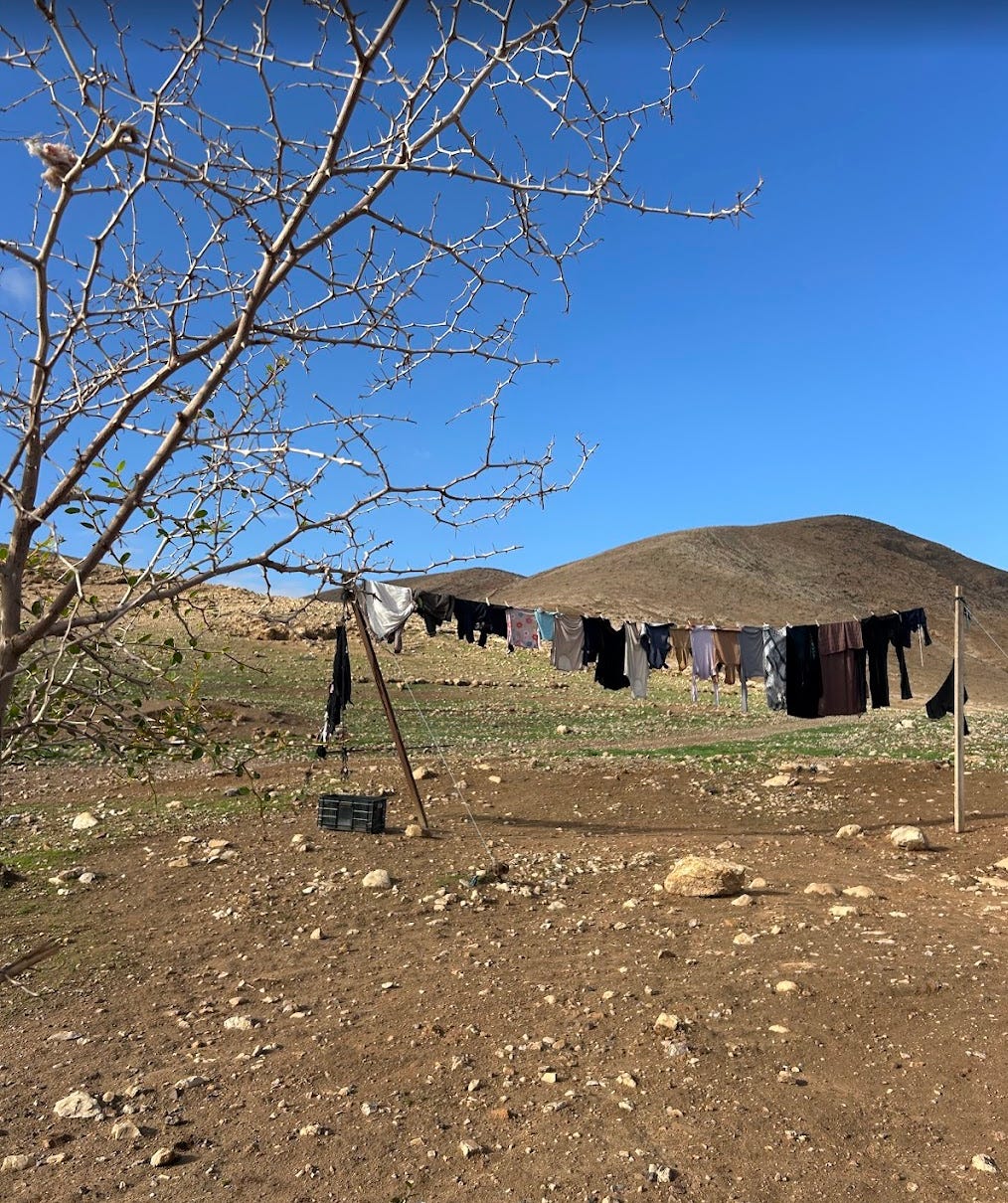
Every day that I have spent putting this together, the situation has changed for the worse. While I was spending the night outside Farsiya, the other half of the group was in Ras Ein al-Auja, a Palestinian Bedouin village of about 700 people between Jericho and Ramallah. After they left on Tuesday, a swarm of 20 settlers attacked the village, sending several people to the hospital. That was December 30th. On January 8th, two of the families that our group stayed with began dismantling their homes to leave. In the days after, 26 families have fled. While volunteers are coming in droves to support them, it’s entirely possible that by the time you read this, Ras Ein al-Auja, the last Palestinian village for miles, will no longer exist. The settlers, backed by the highest levels of the Israeli government, will have succeeded in ethnically cleansing the region.
What is there to be done? Well, you can go. Just as I was leaving, Rabbis for Human Rights sent out an all-hands-on-deck for Ras Ein al-Auja. It was very hard to get on the plane and fly away. But obviously, leaving one’s home and family and job to plant trees or provide protective presence in the West Bank is not feasible for most people. So what else?
Look, there’s no shortage of American problems to call your representatives about, especially given what we’ve seen from ICE in Minnesota this week, and really all year. But the fact remains that this too, is an American problem. In November, a congressional letter stopped demolitions in Umm al-Khair. American political pressure can work, but it is hard-won, and can only do so much.
So this is the part where I ask you for money. Money rebuilds houses. Money gets kids to school, bolsters farmers’ livelihoods, and generally makes it possible for life to continue here.
It’s difficult to give donations directly to Palestinians in the West Bank, but everything I’m linking below is from a trusted organization, many of them run by people that I know personally.
You can provide emergency food aid to Area C communities
You can donate an olive tree to be planted together by Israelis and Palestinians
You can support the crucial future-building work of Breaking the Silence and Rabbis for Human Rights.
This has been the longest-ever edition of Kazakhstan Chronicles. It has been considerably less humorous than average. I just want to say that I so appreciate each and every one of my readers, and thank you for coming along on this journey with me. I spent a lot of time on the trip taking notes and trying to organize my thoughts to be able to convey something of the experience to you all. I hope that you felt that intention.
In the one processing session that I did not skip, we looked at a source sheet (it wouldn’t be a Jewish program without a source sheet). These were the two quotes on it:
In a Jewish Currents article published last year, Palestinian-American writer Sara Aziza wrote that
Perhaps the fundamental work of witness is the act of faith—an ethical and imaginative leap beyond what we can see. It is a sober reverence of, and a commitment to fight for, the always-unknowable other. This commitment does not require constant stoking by grisly, tragic reports. Rather than a feeling, witness is a position. It insists on embodiment, on sacrifice, mourning and resisting what is seen. The world after genocide must not, cannot, be the same. The witness is the one who holds the line of reality, identifying and refusing the lie of normalcy. Broken by what we see, we become rupture incarnate.
And the second quote
“Anyone who knows testimony about another person and is fit to bear witness and testify it, and it has impact on another person– is required to bear witness and testify, whether they alone know the testimony or if there is another person with them”
Tur, Hoshen Mishpat 28:1. ( a 14th-century legal code by Rabbi Jacob ben Asher)
Traditionally, the Jewish style of study relies on a partnership called a chevruta—a kind of study buddy. In writing this, I am asking each of you to be my chevruta. To read and consider these texts with me, to think with me, to mourn with me. To act with me. And I am asking you to witness with me, for whatever that’s worth.
I usually just kind of brain-dump into the Substack editor and hit publish, but this one required significantly more thought. Thank you so much to Peri, Sam, George, and my mom, Susan, (always my best, most exacting editor) for helping me shape this post and for catching my many, many typos.
This is lovely and moving. And there are moments of hope, as in: "There are too many of us, buses of volunteers from Haifa and Jerusalem and Tel Aviv, and not enough shovels and picks, but the farmer seems glad to have us, and patiently corrects our mistakes." "Too many of us" in solidarity. I love that.